


You’ve binged every true crime documentary. You know the O.J. Simpson timeline by heart. You can recite JonBenét Ramsey case theories in your sleep. But have you ever wondered how crime scene investigators actually study these famous cases in forensic science?
While you were obsessing over these cases from your couch, forensic science students were dissecting them in classrooms and crime scene labs. They weren’t debating theories or pointing fingers. They were learning the unglamorous but critical skills that separate actual crime scene investigation from what you see on Netflix: proper chain of custody, contamination control, and realistic expectations about what forensics can actually prove.
If you’re a true crime enthusiast thinking about turning your obsession into a career, understanding how forensic science programs use famous cases as teaching tools is your first step toward the field. Let’s pull back that yellow tape and see what’s really happening in crime scene investigation training.
Key Takeaway:
Forensic science programs use famous cases like O.J. Simpson, JonBenét Ramsey, and the Golden State Killer to teach students critical skills including DNA evidence handling, crime scene security, chain of custody protocols, and the limitations of forensic analysis. These real-world examples show both the power and the pitfalls of forensic investigation.
Find What You’re Looking For in This Guide
- Why CSI Programs Use Famous Cases as Teaching Tools
- The O.J. Simpson Case: DNA Evidence and Chain of Custody
- JonBenét Ramsey: Crime Scene Security and Contamination Control
- Golden State Killer: Cold Cases and Genetic Genealogy
- Inside Crime Scene Houses: Where Theory Meets Practice
- From Netflix to Notebooks: Skills You Really Practice
- The CSI Effect: Unlearning True Crime Expectations
- The Emotional Reality Behind the Cases
- What Programs Look for in CSI Students
- Frequently Asked Questions
- Key Takeaways
Why CSI Programs Use Famous Cases as Teaching Tools
Walk into any forensic science classroom, and you’ll hear names that dominated headlines: O.J. Simpson, JonBenét Ramsey, the Golden State Killer. These aren’t just conversation starters. They’re comprehensive case studies with something most crimes lack: exhaustive documentation.
Famous cases give students access to trial transcripts, evidence photos, expert testimony, and years of analysis. Instructors can show exactly what investigators did right and, more importantly, what they did wrong. When a case goes sideways because someone forgot to log a visitor at the crime scene or mishandled a blood sample, those mistakes are preserved forever in court records for students to study.
These cases also bridge the gap between entertainment and professional reality. Students arrive in forensic science programs with ideas shaped by true crime podcasts and crime dramas. Using familiar cases helps instructors meet students where they are, then gradually show the difference between a documentary’s narrative arc and the meticulous, often tedious reality of forensic work.
The other reason is simple engagement. Students pay more attention when studying the O.J. Simpson case than they do with “Unknown Homicide Case 47B.” That recognition factor matters when you’re trying to teach complex concepts about DNA degradation or the limits of bloodstain pattern analysis.
The O.J. Simpson Case: DNA Evidence and Chain of Custody
If there’s one case that appears in nearly every forensic science curriculum in America, it’s the 1994 O.J. Simpson double murder investigation. Not because it was solved brilliantly, but because it shows what happens when strong forensic evidence meets poor evidence handling.
The Simpson case had everything: blood evidence at multiple locations, DNA matches, fiber evidence, and a bloody glove. On paper, it was overwhelming. In court, defense attorneys tore it apart by questioning how the evidence was collected, stored, and transferred from the scene to the lab.
Forensic science students studying this case discover that having evidence isn’t enough. You need to prove it was collected properly, stored securely, documented meticulously, and never contaminated. Every person who touches evidence must sign for it. Every transfer must be logged. Any gap in that chain of custody gives defense attorneys an opening to argue that the evidence is unreliable.
Programs use the Simpson case to teach DNA collection protocols. Future investigators learn why blood samples must be refrigerated immediately, why technicians can’t carry evidence in personal vehicles, and why every step needs photographic documentation. They practice filling out chain-of-custody forms, understanding that these seemingly boring administrative tasks can make or break a criminal case.
The case also serves as a focal point for discussing the “CSI effect.” The wall-to-wall media coverage of DNA evidence in the Simpson trial helped shape public expectations that every crime scene would yield perfect DNA matches. Forensic science instructors now spend significant time explaining that DNA evidence isn’t always present, isn’t always conclusive, and doesn’t magically solve every case within an hour as it does on television.
JonBenét Ramsey: Crime Scene Security and Contamination Control
When forensic science instructors want to show students exactly what not to do at a crime scene, they turn to the 1996 JonBenét Ramsey case. This investigation is a textbook example of how poor scene security can permanently compromise evidence.
Within hours of discovering JonBenét’s body, multiple people had walked through the house. Family members, friends, and police officers moved through rooms, touched items, and potentially contaminated evidence. Multiple people handled the ransom note before it was properly documented. When investigators later tried to process evidence, they faced impossible questions about who had touched what and when.
The case teaches that the first responders to any scene have one critical job before they do anything else: secure the perimeter. That means establishing a clear boundary, posting guards, and creating a single entry and exit point where everyone entering must sign a log.
Crime scene security isn’t just about keeping curious neighbors away. It’s about controlling contamination. Every person who walks through a scene may leave behind hair, fibers, skin cells, and other trace evidence while disturbing existing evidence. Training programs have students practice setting up scene boundaries in their labs and learn to be obsessive about documenting who enters, when they enter, and what they touch.
The Ramsey case also introduces students to the priorities of evidence preservation. When you arrive at a complex scene, what do you photograph first? What gets collected immediately, and what can wait? How do you balance the need to check for living victims against the need to preserve evidence? These aren’t academic questions when you’re standing in someone’s home processing a real crime scene.
Golden State Killer: Cold Cases and Genetic Genealogy
The 2018 arrest of the Golden State Killer introduced students to the cutting edge of forensic science: investigative genetic genealogy. After decades of dead ends, investigators used DNA from old crime scenes to search public genealogy databases, building family trees that eventually led them to Joseph DeAngelo.
This case demonstrates to students that evidence collected today might be analyzed with technology that won’t exist for another twenty years. That’s why proper collection and storage matter so much. The biological evidence from Golden State Killer crime scenes in the 1970s and 1980s was carefully preserved by investigators who had no idea what future technology might be able to do with it.
Training programs use this case to teach the difference between traditional CODIS database searches, which only match DNA profiles already in the law enforcement system, and investigative genetic genealogy, which uses public databases to identify potential relatives of an unknown suspect. They also discuss the ethical questions this technology raises about privacy, consent, and how far genetic searches should be allowed to go.
The case also emphasizes the importance of meticulous documentation of evidence throughout long investigations. Multiple jurisdictions investigated these cases over decades, using different standards and levels of technology. Future investigators see how early commitment to proper evidence collection made later breakthroughs possible.
Crime scene investigation isn’t just about solving today’s case. It’s about creating an evidence record that will stand up to scrutiny years or even decades later, using technology that doesn’t exist yet.
Inside Crime Scene Houses: Where Theory Meets Practice
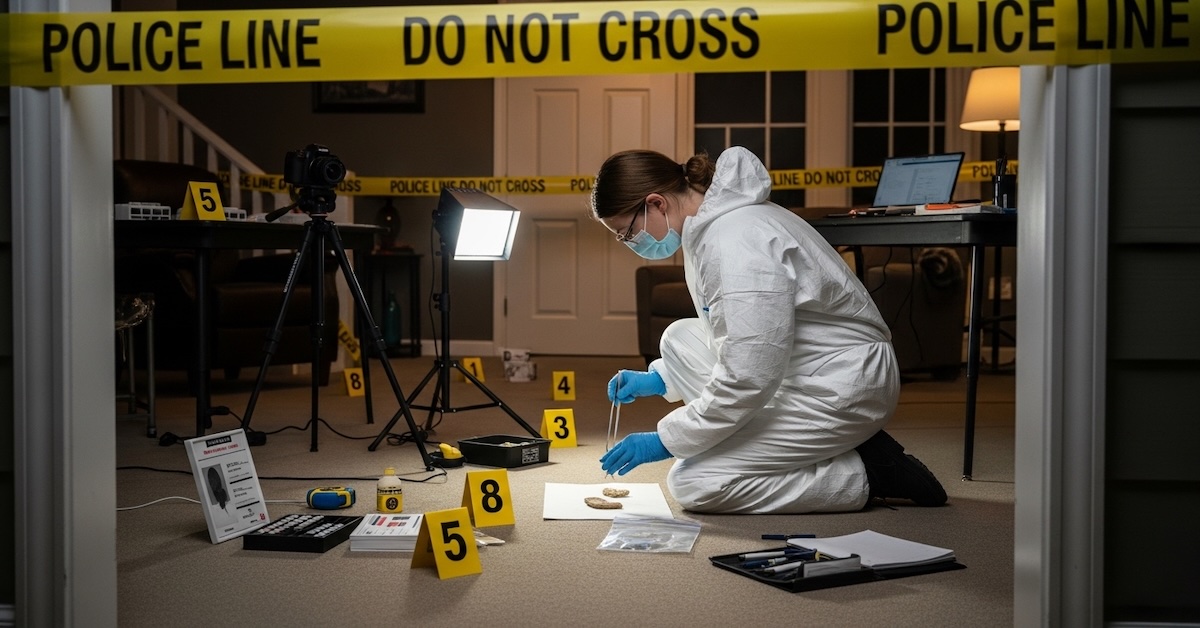
Reading about evidence collection is one thing. Standing in a room with a “body” on the floor, pools of simulated blood, and scattered evidence is entirely different. That’s why many forensic science programs have invested in crime-scene houses or dedicated labs where students conduct realistic mock investigations.
These aren’t simple classroom exercises. Programs set up fully furnished houses or apartments with bedrooms, bathrooms, kitchens, and living areas. Instructors stage elaborate scenes: murders, assaults, burglaries, drug operations. Students arrive knowing only that they’re processing a crime scene. They don’t know what happened or what evidence they’re looking for.
Programs like Fullerton College feature crime scene labs, and Weber State University’s CSI program includes hands-on training exercises. In these settings, students walk into realistic investigation scenarios and see what appears to be a real investigation. They might find a mannequin “victim” with simulated wounds, bloodstain patterns on walls and floors, weapons hidden in unexpected places, and trace evidence scattered throughout multiple rooms.
Students must photograph everything before they touch anything. They sketch the scene, measuring the position of furniture, bodies, and evidence. They document bloodstain patterns and measure impact angles and trajectories. They dust for fingerprints on doors, windows, and weapons. They collect fibers, hairs, and other trace evidence, properly packaging and labeling each item.
This hands-on training reveals how physically demanding and time-consuming crime scene processing actually is. Students spend hours carefully photographing, measuring, and collecting evidence from a single scene. They work in uncomfortable positions, maintain focus despite distractions, and keep detailed notes that will make sense weeks later when they write their reports.
Programs like Ashland University equip their crime scene labs with professional-grade tools: fingerprint powder and brushes, casting materials for shoe and tire impressions, bloodstain pattern analysis equipment, and evidence packaging supplies. Students don’t just read about these tools in textbooks. They use them repeatedly until proper technique becomes second nature.
The most valuable lesson from crime scene house training isn’t technical. It’s learning to slow down. Television crime shows process scenes in minutes. Real crime scene investigation takes hours or even days. Future investigators learn to resist the urge to rush, understanding that a single overlooked piece of evidence or a poorly documented item can derail an entire investigation.
From Netflix to Notebooks: Skills You Really Practice
Your favorite true crime podcast makes forensic investigation sound like detective work with scientific flair. The reality of CSI training is that it focuses more on specific technical skills that take months or years to develop competence in.
Bloodstain pattern analysis sounds dramatic until you’re spending two hours in a spatter room measuring individual droplets, calculating impact angles, and trying to determine whether three blows or four created a pattern. Training programs teach that bloodstain analysis can help reconstruct what happened, but it can’t tell them everything. Was it self-defense or murder? Bloodstains don’t answer that question.
Fingerprint collection and comparison involves patience; most people don’t associate with crime scene work. Future CSIs learn multiple dusting techniques for different surfaces: powder for smooth surfaces, chemical enhancement for porous materials, and alternative light sources for difficult situations. Then comes the tedious part: comparing prints to look for matching ridge characteristics. A partial print found at a scene might take hours to compare against known samples, and many prints are too smudged or incomplete to be useful.
Trace evidence teaches students that tiny fibers, hairs, glass fragments, and soil particles can connect a suspect to a scene. But coursework also emphasizes that trace evidence rarely proves guilt on its own. It’s supporting evidence that fits into a larger picture. Students practice collecting trace evidence with tweezers and tape lifts, learning to spot tiny particles that most people would never notice.
Evidence documentation might be the least glamorous skill, but it’s the most important. Students complete dozens of forms during their training, including chain-of-custody documents, evidence logs, scene sketches, photo logs, and detailed narrative reports. They discover that sloppy paperwork can render perfect evidence useless in court. A good CSI is as much a meticulous administrator as a scientist.
The skills students practice aren’t the high-tech gadgetry you see on television. They’re fundamental techniques that haven’t changed much in decades: careful observation, systematic documentation, proper handling of evidence, and attention to detail that borders on the obsessive.
The CSI Effect: Unlearning True Crime Expectations
Here’s a conversation that happens in nearly every introductory forensic science class. A student asks: “Why don’t they just run the DNA and find out who did it?” The instructor has to explain that DNA analysis takes weeks, not hours. That many crimes don’t leave DNA evidence. That DNA matches only tell you someone was present, not that they committed a crime.
The CSI effect is real, and it affects everyone from students to juries. Television crime dramas have created expectations about forensic science that don’t match reality. Juries now expect DNA evidence in every case, even when it’s not realistic or scientifically necessary. They expect clear fingerprints, video footage, and high-tech analysis that solves crimes definitively.
Forensic science instructors spend considerable time managing these expectations. They show students famous cases in which perfect DNA evidence existed but didn’t lead to a conviction because other factors mattered more. They demonstrate how partial fingerprints, contaminated samples, and ambiguous results are normal parts of real investigations.
Coursework also notes that much of crime scene work involves property crimes, such as burglaries, vehicle break-ins, and vandalism. These cases rarely yield dramatic evidence. There’s no DNA sample to analyze. The fingerprints are smudged. The security footage is grainy. Future investigators learn to work these cases professionally, even though they lack the drama of televised homicide investigations.
The CSI effect cuts both ways. It brings enthusiastic students into forensic science programs, people who might never have considered the field without true crime entertainment. But instructors must then carefully reshape those expectations toward reality. The goal isn’t to discourage students. It’s to prepare them for a career where patience, persistence, and meticulous documentation matter more than dramatic revelations.
The Emotional Reality Behind the Cases
There’s a moment many forensic science students remember clearly. An instructor brings in real crime scene photos, not textbook illustrations or staged mock scenes, but actual documentation from homicides, child abuse cases, or severe assaults. That’s when students realize what true crime entertainment has shielded them from: real violence is disturbing in ways dramatizations never capture.
Current forensic professionals describe how their relationship with true-crime entertainment changed after working on real cases. The podcasts they once enjoyed feel exploitative. The documentary speculation seems disrespectful to victims and their families. Real crime isn’t entertainment when you’re the one collecting evidence from someone’s worst day.
Future CSIs need to develop emotional resilience for this field. You will see graphic injuries. You will work cases involving children. You will process evidence from sexual assaults. You will smell decomposition. These aren’t occasional experiences. They’re regular parts of the job that you can’t fast-forward through or turn off when they become uncomfortable.
Forensic science programs increasingly address these realities directly in coursework. Students discuss coping strategies, the importance of peer support networks, and warning signs of burnout or secondary trauma. Some programs connect students with mental health professionals who specialize in working with law enforcement and forensic personnel.
The job also affects your personal life. You’ll work nights, weekends, and holidays because crime doesn’t follow a nine-to-five schedule. Major cases require an immediate response and may cancel your plans without notice. But current professionals also describe deep satisfaction with the work: the intellectual challenge of reconstructing what happened from physical evidence, the sense of purpose in helping bring justice for victims, and the moment when that one piece of evidence you meticulously collected becomes the key to solving a case.
What Programs Look for in CSI Students
The students who thrive in forensic science programs and later in CSI careers share certain traits that have nothing to do with binge-watching true crime documentaries.
Attention to detail matters more than intelligence or creativity. Can you spend three hours documenting a single room without cutting corners? Will you spot a tiny fiber that might be important or walk right past it? The difference between good and mediocre crime scene investigators often comes down to patience and thoroughness.
Emotional steadiness becomes apparent during training. Some students encounter their first autopsy photos or decomposition case studies and realize they can’t handle it. That’s okay, but it’s better to discover it in a classroom than after you’ve started a career. Programs look for students who can compartmentalize when necessary while still maintaining empathy for victims.
Scientific curiosity drives you to understand why techniques work rather than just memorizing procedures. Why does luminol react to blood? What makes fingerprints unique? How does DNA degradation affect analysis? Students who constantly ask “why” tend to become better investigators because they understand the limitations and possibilities of their tools.
Communication skills surprise many students. You’re not working alone in a lab. Crime scene investigators collaborate with police officers, detectives, medical examiners, prosecutors, and defense attorneys. You’ll write reports that non-scientists must understand. You might testify in court, explaining complex forensic concepts to juries. Being able to communicate clearly matters as much as technical competence.
Physical stamina is rarely mentioned in true crime shows, but crime scene work is physically demanding. You’ll crouch, kneel, climb, and reach into awkward positions for hours. You’ll work outside in heat, cold, rain, and darkness. You’ll carry equipment cases weighing fifty pounds or more. Physical fitness isn’t a minor consideration.
Flexibility with irregular hours eliminates some candidates immediately. Can you drop everything and respond to a scene at 2 AM? Can you work holidays and weekends? Will you cancel family plans when a major case requires your presence? If you need predictable hours and a stable schedule, crime scene investigation isn’t the right career choice.
Programs want students who understand these realities before investing years in training. The most successful students come in with realistic expectations, strong study habits, and a genuine commitment to meticulous work rather than dramatic breakthroughs. If you’re ready to commit to becoming a crime scene investigator, understanding these demands is essential.
Frequently Asked Questions
Do CSI programs really study famous murder cases?
Yes, forensic science programs regularly use famous cases like O.J. Simpson, JonBenét Ramsey, and the Golden State Killer as teaching tools. These cases offer comprehensive documentation, including trial transcripts, evidence photos, and expert testimony that illustrate both successful forensic techniques and costly mistakes. Instructors use them to teach DNA evidence handling, crime scene security, chain-of-custody protocols, and the limitations of forensic analysis.
How graphic is CSI training?
CSI training includes exposure to graphic crime scene photos, autopsy documentation, and simulated scenes with realistic injuries and bloodstains. While programs use staged scenes with mannequins for hands-on training, students also view actual crime scene photographs and may observe autopsies as part of their education. Programs increasingly prepare students for this exposure and provide mental health support resources.
Will studying forensic science ruin true crime shows for me?
Many forensic science students and professionals report that their relationship with true crime entertainment changes after studying real cases. The dramatization, speculation, and sometimes disrespectful treatment of victims in entertainment can feel uncomfortable when you understand the reality behind the investigations. However, some professionals still enjoy true crime content while maintaining a more critical perspective on its accuracy and ethics.
What degree do I need to become a crime scene investigator?
Many agencies prefer or require a bachelor’s degree in forensic science, criminal justice, chemistry, biology, or a related field. Requirements vary by jurisdiction—some smaller agencies may hire candidates with associate degrees or certificates combined with relevant experience. Forensic science degrees offer the most direct preparation, but some investigators start with degrees in hard sciences and receive CSI training on the job. Check specific job postings in your target area, as educational requirements differ by agency size and location. Many positions also require successful completion of a training academy after hire.
How long does CSI training take?
A bachelor’s degree in forensic science typically requires four years of full-time study. After graduation, new hires usually complete several months of on-the-job training with experienced investigators before working scenes independently. Some agencies require completion of a police or forensic academy, adding several additional months of training. Total preparation from starting college to becoming a fully trained CSI typically takes five to six years.
Are there hands-on crime scene labs at most programs?
Many forensic science programs now offer hands-on crime scene training facilities, though they vary in sophistication. Some programs have dedicated crime scene houses with multiple rooms staged as realistic investigation scenes. Others use lab spaces that can be configured for different scenarios. When researching programs, ask specifically about hands-on training opportunities, crime scene facilities, and student-to-instructor ratios during practical exercises.
What’s the job market like for CSIs?
According to the U.S. Bureau of Labor Statistics, forensic science technician positions are projected to grow steadily, though competition can be strong in desirable locations. Smaller agencies may hire less frequently, while larger urban departments have more regular openings. Many new graduates start in property crime or evidence processing positions before moving into major crime scene investigation. Salaries vary significantly by location and agency. Learn more about crime scene investigator salary expectations across different states and experience levels.
Key Takeaways
Famous cases in forensic science education serve as comprehensive teaching tools because they offer detailed documentation of both successful techniques and critical mistakes. Cases like O.J. Simpson, JonBenét Ramsey, and the Golden State Killer appear regularly in coursework to illustrate real-world applications of forensic science principles.
Crime scene investigation training emphasizes meticulous documentation and evidence handling more than dramatic breakthroughs. Students spend significant time learning chain of custody protocols, contamination prevention, proper photography and sketching, and administrative procedures that ensure evidence remains admissible in court.
Hands-on crime scene house training reveals the physical demands and time requirements of real investigations. Processing a single scene takes hours of careful work, challenging students to develop patience and attention to detail that entertainment media rarely portrays.
The CSI effect creates unrealistic expectations that programs must address directly. Students discover that DNA evidence isn’t always available, forensic analysis takes weeks not hours, and many cases involve ambiguous or incomplete evidence rather than clear-cut conclusions.
Emotional resilience and irregular hours are part of the career reality. Students must be prepared for graphic scenes, disturbing cases, night and weekend work, and the mental health challenges that come with regular exposure to violence and tragedy.
Ready to turn your true crime interest into a real career?
The right forensic science program offers more than famous case studies—it provides hands-on training, experienced faculty, and strong connections to local law enforcement agencies. Explore crime scene investigation programs by state to find the training that will prepare you for the reality behind the yellow tape, not just the entertainment version.