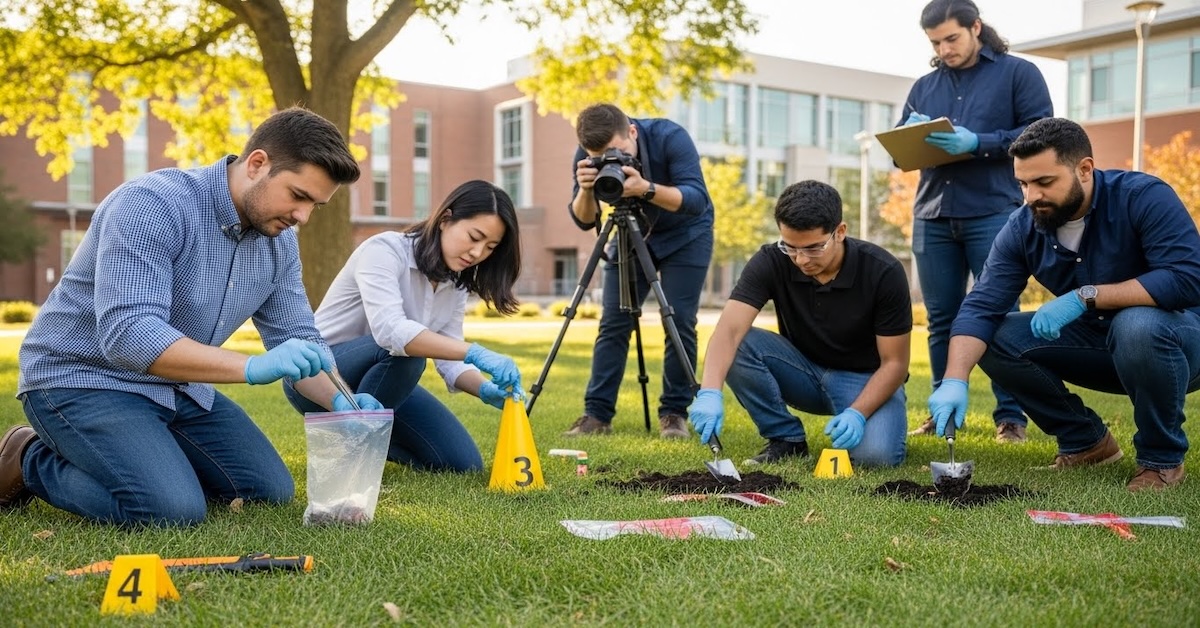


Becoming a crime scene investigator takes commitment, planning, and patience. Most students spend 5 to 6 years moving from their first college class to working independently at crime scenes. If you’re researching how to become a forensic scientist, that timeline can feel overwhelming when you’re just starting.
This guide breaks down your entire CSI education timeline month by month. You’ll know exactly what to expect during each phase, from first-year science courses through field training as a new hire. No more guessing about when to apply for internships or how long the hiring process takes.
Key Takeaway:
The path from college student to working crime scene investigator spans approximately 60 to 72 months. This includes four years of undergraduate education, 6 to 12 months of job searching and hiring processes, and 3 to 12 months of supervised field training before you work cases independently.
Find What You’re Looking For in This Guide
- Your CSI Education Timeline at a Glance
- Before College: High School Preparation
- Year One: Building Your Science Foundation
- Year Two: When Specialization Begins
- Year Three: Advanced Forensics and Professional Growth
- Year Four: Capstone, Certification, and Job Hunting
- After Graduation: Employment and Field Training
- What Separates Successful CSI Candidates
- Common Mistakes That Derail CSI Careers
- Frequently Asked Questions
- Key Takeaways
Your CSI Education Timeline at a Glance
Before diving into the details, here’s a bird’s-eye view of your complete journey. Use this table as a quick reference as you plan each phase of your education.
| Phase | Timeframe | Key Milestones |
|---|---|---|
| High School Prep | Months -12 to 0 | Strong science grades, forensic summer camps, and college applications |
| First Year | Months 1-12 | Chemistry, biology, physics foundations; build professor relationships |
| Sophomore Year | Months 13-24 | Organic chemistry, CSI courses, begin internship search, maintain 3.0+ GPA |
| Junior Year | Months 25-36 | Advanced forensics, complete internship (critical milestone) |
| Senior Year | Months 37-48 | Capstone project, job applications, graduation |
| Job Search | Months 49-54 | Applications, interviews, background investigations |
| Field Training | Months 55-72+ | On-the-job training, mentored casework, certification eligibility |
Before College: High School Preparation (Months -12 to 0)
Your CSI journey actually begins before you set foot on a college campus. The year before college matters more than most students realize.
Focus on building a strong foundation in science and mathematics courses. Biology, chemistry, physics, and calculus aren’t just college requirements. They’re essential building blocks for every forensic technique you’ll learn later. Students who struggle with these subjects in high school often find themselves overwhelmed by the rigorous science curriculum in forensic science programs.
Consider participating in science fairs, forensic science clubs, or volunteer opportunities with local law enforcement during your senior year. These experiences strengthen your college applications while confirming your interest in the field.
Summer forensic science camps offer hands-on exposure before college begins. Universities like Penn, Yale, and Georgetown run 1- to 2-week residential programs where high school students process simulated crime scenes, work in laboratories, and learn from forensic professionals. These programs help you understand what the career truly involves, not just what you’ve seen on television.
Year One: Building Your Science Foundation (Months 1-12)
Fall Semester: The Reality Check (Months 1-4)
Your first semester hits hard. Expect intensive science coursework that may require 30 to 40 hours of study time outside class each week, especially for STEM majors. A typical course load includes General Chemistry I with lab, Calculus I, Physics I with lab, English Composition, and an Introduction to Forensic Science course. That’s 15 to 17 credit hours of demanding material.
The introduction to forensic science course provides your first real glimpse into the field. You’ll learn about crime scene procedures, evidence types, and legal considerations. Meanwhile, chemistry, physics, and calculus form the scientific backbone you’ll need for advanced forensic techniques in later years.
Many students experience a reality check during these first months. The workload is heavier than in high school, and the science courses move faster. This is normal. Push through this adjustment period, as it becomes more manageable once you adapt to college-level expectations.
Spring Semester: Momentum Builds (Months 5-8)
Spring semester continues the science foundation with General Chemistry II, Calculus II, Physics II (all with labs), and English Composition for Research. The workload remains intense, but you’ve adapted to college demands by now.
Laboratory work intensifies during this semester. You’ll learn to work with microscopes, preserve different types of evidence, and document crime scenes properly. These practical skills separate classroom knowledge from professional competency.
Build relationships with your professors during this semester. Attend office hours, ask questions, and show genuine interest in the material. These connections matter enormously for future recommendation letters, research opportunities, and internship referrals. Professors often know about opportunities that never get publicly advertised.
Summer: First Strategic Steps (Months 9-12)
Your first college summer offers several pathways. Some students use this time to catch up academically or work summer jobs to fund their education. Both are valid choices. Learn more about financing your CSI education through work-study and internships.
However, forward-thinking students begin volunteering with local police departments or medical examiner offices. These positions may be unpaid or minimally compensated, but they provide crucial early exposure to the field. More importantly, they strengthen your internship applications for the following year.
If you maintained a GPA of 3.0 or higher, start researching internship programs for next summer. Most competitive forensic internships require applications by January, so early research gives you a significant advantage.
Year Two: When Specialization Begins (Months 13-24)
Fall Semester: Organic Chemistry and CSI Techniques (Months 13-16)
The second year introduces organic chemistry, which is often the most challenging course in the forensic science curriculum. Your schedule typically includes Organic Chemistry I, Introduction to Computer Science, Crime Scene Investigation with Lab, and Statistics or Probability. This 15- to 16-credit-hour schedule balances challenging chemistry with exciting forensic-specific coursework.
The Crime Scene Investigation course represents a significant milestone. You’ll learn proper crime-scene processing, photography techniques, evidence collection methods, and chain-of-custody procedures. Many programs include mock crime-scene exercises in which you process simulated scenes from start to finish.
Your GPA matters more than ever this semester. Most internship programs require a minimum 3.0 GPA, though some agencies accept slightly lower GPAs or evaluate candidates holistically based on relevant experience and coursework. Still, dropping below 3.0 limits your options significantly and blocks access to many competitive programs.
Spring Semester: Internship Preparation (Months 17-20)
Organic Chemistry II continues the challenging chemistry sequence. You’ll also take forensic-specific electives covering topics such as fingerprint analysis, trace evidence examination, and forensic biology basics.
This semester, begin intensive internship searching. The forensic internship market is highly competitive. Many crime labs don’t advertise their internships publicly because they receive more applications than they can handle without any marketing.
Start by researching every police department, crime lab, and medical examiner’s office within your willing travel radius. Cold emails expressing interest often yield results that formal job boards miss. Connect with your program’s faculty, who usually know about unadvertised opportunities.
Summer: Prime Application Season (Months 21-24)
If you secured a summer internship, you’re ahead of many peers. Forensic internships typically run for seven or more weeks and require 8 to 40 hours per week. You’ll work under supervision, processing evidence, assisting with crime scenes, or supporting laboratory analyses.
Interns cannot handle active casework directly at accredited labs. However, you’ll shadow professionals and learn agency-specific protocols. This experience proves invaluable during job interviews when you can speak knowledgeably about real-world procedures.
Not all students secure internships on their first attempt. The competition is fierce, with labs often receiving hundreds of applications for a handful of positions. If you didn’t land an internship, use this summer productively. Work in a hospital lab, take additional coursework, or pursue certifications in CPR and first aid.
Year Three: Advanced Forensics and Professional Growth (Months 25-36)
Fall Semester: Specialized Techniques (Months 25-28)
The third year delivers advanced forensic courses that feel genuinely exciting. Physical Methods of Forensic Analysis, Forensic Microscopy, and specialized topics like DNA analysis or fingerprint examination fill your schedule. These courses require extensive laboratory work and build directly on your earlier science foundation.
Forensic microscopy teaches you to identify and analyze trace evidence, including fibers, hair, glass, soil, and other materials found at crime scenes. Physical methods courses introduce sophisticated instrumentation like gas chromatography, mass spectrometry, and spectrophotometry.
If you haven’t completed an internship yet, this semester offers another application window. Some agencies provide internships that run from September through November. Continue networking with professionals and consider joining the American Academy of Forensic Sciences, which offers student memberships.
Spring Semester: Concentration Deepens (Months 29-32)
Advanced forensic courses continue with options in forensic chemistry, forensic biology, or criminalistics, depending on your program’s concentrations. You’ll also take Law and Evidence, learning legal requirements for evidence admissibility and courtroom procedures.
Many students complete their main internship during the spring semester, when agencies have fewer internship applicants than during the summer. A spring internship interferes less with summer job opportunities while still providing essential hands-on experience.
This semester, begin thinking about your senior capstone project. You’ll need to identify a research topic, methodology, and potentially a placement site. Start conversations with professors about possible projects and ask about their research interests.
Summer: Critical Internship Window (Months 33-36)
The summer between junior and senior year represents the ideal internship window. You’ve completed most core coursework, understand forensic fundamentals, and can contribute meaningfully to an agency or lab. Internships during this period often span 12 to 16 weeks, providing deeper immersion than shorter programs.
For capstone requirements, many programs mandate 90 to 120 contact hours in a lab or justice system environment. Summer internships often fulfill this requirement while simultaneously providing the practical experience employers seek.
Document every technique learned, instrument used, and procedure practiced. Take photos where permitted for your professional portfolio. Request LinkedIn recommendations from supervisors while your performance is fresh in their minds.
Year Four: Capstone, Certification, and Job Hunting (Months 37-48)
Fall Semester: Senior Projects Begin (Months 37-40)
Senior year arrives with capstone courses, advanced electives, and the reality of impending job searches. Your capstone project begins this semester and requires a substantial research project that demonstrates mastery of forensic concepts.
Capstone projects typically require 90 to 120 contact hours in a forensic setting, an 8 to 110-pagescientific paper on your research, and a formal presentation to faculty and potentially working professionals. Recent projects have included topics such as fiber dye analysis validation, drone applications for collision-scene documentation, and new methods for separating drug isomers.
Simultaneously, begin job applications. The hiring process for CSI positions averages 2 to 6 months, with some taking over 2 years from application to offer. Starting early gives you the best chance of employment shortly after graduation.
Spring Semester: Intensive Job Search (Months 41-44)
Your final semester involves completing your capstone project, finishing coursework, and relentless job searching. The capstone culminates in a formal presentation where you defend your research conclusions to a faculty committee.
Continue applying to positions throughout this semester. Many agencies require extensive applications covering your background, education, and experience in detail. The review process alone takes weeks as hiring committees evaluate hundreds of qualified applicants.
Geographic flexibility dramatically increases your chances of finding employment. Students willing to relocate anywhere have vastly better prospects than those limited to specific regions.
Summer After Graduation: The Gap Period (Months 45-48)
Many graduates spend 3 to 6 months after graduation continuing their job search. This is normal in a competitive field with limited openings.
Use this time productively. Pursue additional certifications, volunteer with agencies, or work in related positions like evidence technician or lab assistant. Entry-level positions as evidence technicians often lead to CSI promotions and provide valuable experience during the gap period.
After Graduation: Employment and Field Training (Months 49-72+)
The Hiring Process (Months 49-54)
Once you receive a conditional job offer, extensive background investigations begin. Most law enforcement agencies conduct criminal history checks, credit reports, polygraph examinations, drug testing, reference checks, and education verification.
This process typically requires 2 to 3 months but can extend to 6 months. During this period, agencies verify every detail of your application and assess your suitability for handling sensitive evidence and information.
Field Training Programs (Months 55-66)
Your first year on the job involves intensive training. Learn more about field training and agency-specific protocols to understand what awaits you. The structure and duration vary significantly by agency and position type.
| Position Type | Training Duration | What’s Covered |
|---|---|---|
| Sworn CSI (with police academy) | 20-22 weeks | Law enforcement procedures, evidence handling, legal requirements, and academy protocols |
| Civilian CSI | 3-12 months | Agency-specific procedures, mentored crime scene processing, and report writing |
| DNA Analyst | 12-24 months | DNA extraction, amplification, analysis, interpretation, courtroom testimony |
| Drug Chemist | 12 months | Controlled substance identification, instrumentation, and legal protocols |
| Firearms Examiner | 24 months | Ballistics analysis, toolmark comparison, courtroom testimony |
During training, you’ll work under supervision and gradually assume greater responsibilities. Expect to process increasingly complex crime scenes, prepare evidence for analysis, write detailed reports, and potentially provide courtroom testimony while your mentor observes.
Working Toward Certification (Months 60-72+)
After one year of employment, you become eligible for entry-level professional certification. The International Association for Identification (IAI) offers the Certified Crime Scene Investigator (CCSI) credential, which requires one year of experience, 48 hours of board-approved training, and passing a comprehensive examination.
| Certification Level | Experience Required | Training Hours |
|---|---|---|
| Certified Crime Scene Investigator (CCSI) | 1 year | 48 hours |
| Certified Crime Scene Analyst (CCSA) | 3 years | 96 hours |
| Certified Crime Scene Reconstructionist (CCSR) | 5 years | 120 hours |
| Certified Senior Crime Scene Analyst (CSCSA) | 6 years | 144 hours |
Certification isn’t universally required, but it demonstrates competency and commitment to professional standards. Many agencies offer pay increases or promotional preference for certified investigators.
What Separates Successful CSI Candidates
After reviewing countless student experiences and hiring patterns, several factors consistently separate those who land CSI positions from those who struggle.
Internships matter more than grades, but grades unlock internships. Most competitive internships require a 3.0 GPA minimum. You need strong academic credentials to access practical experience, and that experience becomes your greatest asset. Students who let their GPA slip below 3.0 often find themselves locked out of the opportunities that lead to employment.
Networking creates opportunities that job boards miss. Agencies prefer hiring candidates they’ve worked with through internships or volunteer programs. When you’ve already proven you can handle crime scenes, maintain evidence integrity, and work effectively with the team, you’re not a hiring risk. Build relationships with everyone you meet in the field.
Geographic flexibility multiplies your chances. The Bureau of Labor Statistics projects 2,600 new forensic science technician jobs from 2024 to 2034, representing 13% growth, which is much faster than average. Students willing to relocate anywhere have vastly better prospects than those limiting their search to one city or region.
Persistence through rejection defines eventual success. Many successful CSIs applied to 70 or more positions before receiving an offer. Rejection is standard in this competitive field. What separates those who eventually succeed is simply refusing to give up while continuing to build experience and skills.
Common Mistakes That Derail CSI Careers
Understanding common pitfalls helps you avoid them. These mistakes consistently hold back otherwise qualified candidates.
Letting your GPA drop below 3.0 blocks access to many internship opportunities, creating a barrier that’s difficult to overcome. While some agencies evaluate candidates holistically, a sub-3.0 GPA significantly narrows your options. If your grades are slipping, consider reducing your course load while working in a hospital lab or related field. This strategy rebuilds your GPA while strengthening your resume with practical experience.
Waiting too long to apply for internships leaves you competing for scraps. Start researching no later than sophomore year, though earlier is even better. Many students don’t begin until junior or senior year, by which time preferred internships are already filled or waitlisted months in advance.
Expecting the job to match television creates disappointment. Real CSI work involves extensive paperwork, result timelines measured in days or weeks rather than minutes, and specialization in specific evidence types rather than investigating entire cases. Understanding this reality helps you appreciate the actual work.
Giving up after rejections ends promising careers prematurely. Receiving 50 to 80 rejection letters before getting hired is normal in this field. Each application increases your odds, and many successful CSIs report their hiring came from an unexpected source after months or years of searching.
Frequently Asked Questions
How long does it take to become a crime scene investigator?
The complete path from starting college to working independently as a CSI spans approximately 60 to 72 months. This includes 4 years for a bachelor’s degree, 6 to 12 months for job searching and hiring processes, and 3 to 12 months of supervised field training. Some specialized laboratory positions require 18 to 24 months of additional training.
What degree do I need to become a CSI?
Most CSI positions require a bachelor’s degree in forensic science, biology, chemistry, or a related natural science. Some agencies accept criminal justice degrees for civilian CSI roles, but science-heavy programs provide stronger preparation. A chemistry or biology degree offers flexibility if you decide to pursue other scientific careers.
When should I start looking for forensic science internships?
Begin researching internships no later than your sophomore year and submit applications by January for summer positions. The forensic internship market is highly competitive, and many labs fill their positions months in advance without public advertising. Early preparation and networking with professors dramatically improve your chances.
Do I need certification to work as a crime scene investigator?
Certification is not universally required, but it demonstrates professional competency. You become eligible for the Certified Crime Scene Investigator (CCSI) credential after one year of experience and 48 hours of approved training. Many agencies offer pay increases or promotional preference for certified investigators.
How competitive is the CSI job market?
The market is highly competitive. Agencies often receive hundreds of applications for single positions, and many candidates apply to 50 or more jobs before accepting an offer. Geographic flexibility, internship experience, and persistence significantly improve your chances. The Bureau of Labor Statistics projects 2,600 new forensic science technician jobs from 2024 to 2034, with the field growing 13%, much faster than average.
Key Takeaways
- Plan for a 60 to 72-month journey from starting college to working independently as a crime scene investigator.
- Maintain a 3.0 or higher GPA to access competitive internship opportunities that employers value most.
- Begin internship research no later than the sophomore year and apply by January for summer positions.
- Complete at least one substantive internship, ideally between junior and senior year, when you can contribute meaningfully.
- Start job applications in the fall of senior year, since hiring processes often take 2 to 6 months or longer.
- Expect 3 to 12 months of field training before working cases independently.
- Consider geographic flexibility to multiply your employment opportunities in a competitive market.
- Prepare for rejection and maintain persistence, as many successful CSIs applied 50 or more times before receiving offers.
Ready to start your CSI education journey? Explore accredited forensic science programs that match your goals and location preferences.
2024 US Bureau of Labor Statistics salary and employment figures for Forensic Science Technicians reflect state and national data, not school-specific information. Conditions in your area may vary. Data accessed December 2025.